7 Science-Backed Habits of 150+ WPM Typists
Elite typists do not move their fingers three times faster—they buffer words ahead, fire motor chunks, protect 98% accuracy, and train weak keys under ranked pressure.
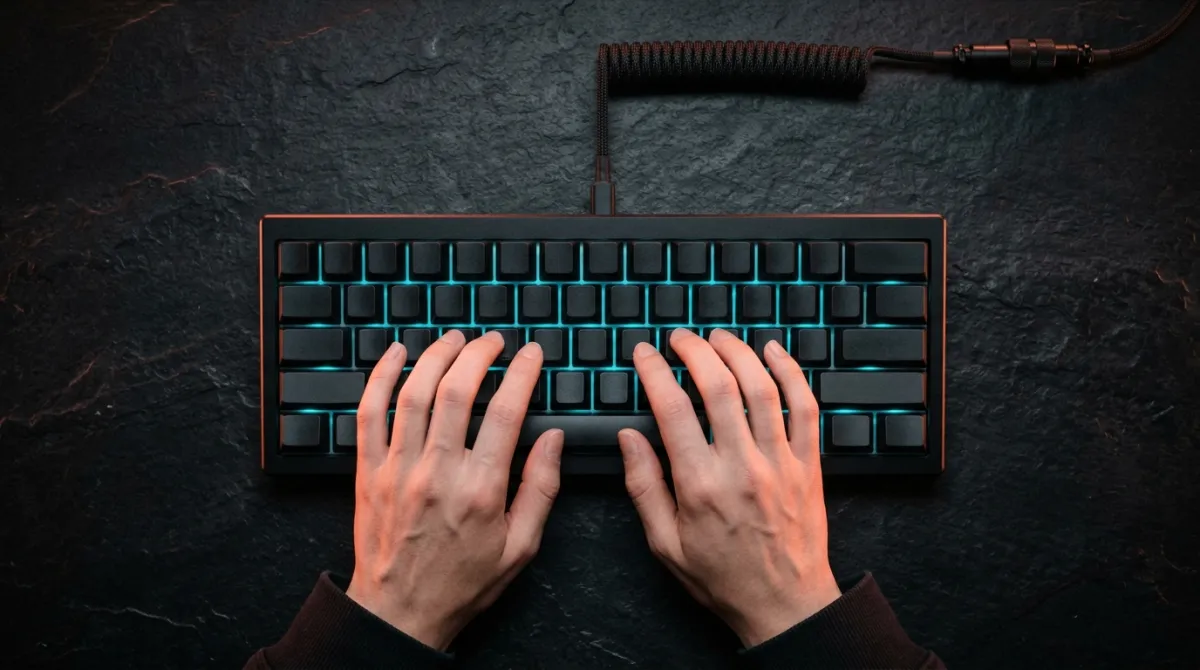
Crossing 150 words per minute looks superhuman from the outside, yet biomechanical studies of skilled typists reveal a surprising truth: grandmaster typists do not wiggle individual fingers three times faster than a 65 WPM office worker. At 150 WPM, the average inter-keystroke interval sits around 80 milliseconds—faster than conscious visual feedback can verify a single key press.
That single constraint explains everything about elite keyboard speed. Once you move past 80 WPM, conscious letter-by-letter control hits a biological wall. Breaking into the 120–170 WPM tier requires rewiring how your eyes read text, how your motor cortex groups sequences, and how you manage friction on the keyboard.
Below are the seven science-backed habits that separate steady 150+ WPM racers from typists stuck on a mid-level plateau.
1. Visual Look-Ahead Buffering (1.5 to 2 Words Ahead)
If your eyes track the exact character your fingers are pressing right now, your hands are forced to wait on visual decoding between words. Fast typists decouple eye fixation from finger execution, maintaining a rolling visual buffer 1.5 to 2 words ahead of the cursor.
Think of it like sight-reading sheet music. While your fingers finish executing "through", your eyes are already parsing "the" and "window". Because the brain queues the upcoming word in working memory, there is zero micro-pause across the spacebar.
To train look-ahead buffering without overwhelming your accuracy:
- Run a 1-minute speed test at 85% of your maximum pace and consciously force your gaze one full word past the active highlight.
- Notice where your eyes snap back toward errors—those snap-backs reveal low-confidence keys that still demand visual supervision.
2. Motor Chunking Instead of Single-Letter Keystrokes
Beginners operate in serial mode: see t → move left index → see h → move right index → see e → move left middle. At 150 WPM, the brain compiles frequent two-letter bigrams (th, he, in, er, an) and three-letter trigrams (ing, tion, ment, the) into unified motor chords.

Even though keys are pressed sequentially, the motor program fires as one overlapping wave: the second finger begins descending before the first finger fully lifts. Alternating-hand transitions (t-h-e, w-o-r-k, s-i-g-n) can overlap down to 45–60 milliseconds because opposing hands operate without mechanical interference.
| Metric | 55 WPM Typist | 100 WPM Typist | 150+ WPM Typist |
|---|---|---|---|
| Primary execution unit | Single characters | Short syllables | Whole words & affixes |
| Visual look-ahead | 0–2 characters | 4–7 characters | 8–14 characters |
| Same-finger bigram delay | 190–240 ms | 120–150 ms | 75–105 ms |
| Target accuracy floor | 93–95% | 96–97% | 98–99% |
3. Enforcing a 98% Accuracy Lock
The single biggest myth in typing practice is that you should push reckless burst speed first and clean up errors later. In reality, sloppy bursts train noisy motor pathways. When you mistype "separate" as "seperate" half the time, your muscle memory encodes hesitation and error-correction loops.
Consider the math on a 300-character sprint: a single typo triggers a wrong stroke, a Backspace strike, a re-typed character, and roughly 300 milliseconds of cognitive disruption. Five preventable typos inside one minute easily erase 12 to 18 Net WPM.
Top racers enforce an accuracy floor of 98% or higher during deliberate practice. Whenever accuracy dips below 96%, they drop cadence by 10% until clean rhythm returns.
4. Floating Wrists and Minimal Keystroke Travel
Watch video footage of elite typists and you will notice how still their hands look. There are no dramatic finger arcs, no bouncing palms, and no stiff forearm pivots.
Three biomechanical habits preserve speed across long sessions:
- Float the wrists slightly above the desk rather than anchoring the carpal tunnel onto a hard edge, allowing the forearm to glide laterally for outer punctuation and Enter strokes.
- Stay within 2–3 millimeters of the keycaps between strikes; high finger lift adds wasted round-trip travel time on every word.
- Avoid bottoming out aggressively: tactile or linear switches actuate halfway down the stroke (~2.0 mm). Light, controlled bottoming protects tendons and cuts rebound latency.

5. Surgical Weak-Key & SFB Isolation
General typing tests spend 80% of your repetitions on easy home-row letters you already automate. Your true speed ceiling is set by your slowest 10% of transitions—especially same-finger bigrams (SFBs) such as de, ed, fr, sw, ju, lo, and awkward pinky reaches.
Instead of grinding random 60-second tests all evening, fast typists audit their per-key latency and isolate problem pairs in targeted typing drills. Five minutes spent eliminating hesitation on ce, br, qu, and mp transfers immediately into smoother full-paragraph flow.
Daily 10-Minute Weak-Key Protocol
- Complete two baseline runs and check which bottom-quartile keys show latency spikes or elevated typo rates.
- Load a focused drill featuring words packed with your slowest three bigrams at a strict 98% accuracy goal.
- Finish with one clean, unhurried full-passage run to lock those newly smoothed transitions back into natural context.
6. Rhythmic Cadence Over Frantic Bursting
Inexperienced typists accelerate violently on simple three-letter words (and, the, for) and slam into the brakes whenever a longer word (extraordinary, infrastructure) appears. Those sharp speed swings cause finger collisions and missed spaces.
Grandmaster typists ride a smoother metronome. By slightly pacing easy words—say, typing "the" at 155 WPM rather than a reckless 195 WPM—your visual buffer stays stocked and complex multi-syllable words glide smoothly at 135 WPM without tripping. Steady cadence routinely outperforms choppy burst-and-crash sprints on both Net WPM and consistency metrics.
7. Training Under Live Ranked Pressure
Solo practice carries an invisible flaw: the instant you make an ugly mistake, you can hit Tab or Esc to reset your score. That restart habit feels productive, yet it leaves you unprepared when a real race, job assessment, or live match demands composure after a stumble.
Stepping into a ranked 1v1 typing duel changes the psychological feedback loop immediately. Seeing a live opponent progress bar move beside yours forces three critical adaptations:
- Zero-panic error recovery: you learn to execute a crisp
Ctrl+Backspaceor clean correction and immediately re-lock your look-ahead buffer. - Adrenaline calibration: mild competitive stress reveals exactly which letters break down when your heart rate climbs.
- Measurable progression: an ELO rating tracks real consistency over dozens of opponents rather than cherry-picked lucky runs.
Putting All 7 Habits Into Practice Today
You do not need to overhaul every habit on day one. Start by taking a clean diagnostic on our typing speed test to record your current Net WPM and accuracy baseline. Next, spend 10 minutes smoothing your slowest transitions inside adaptive key drills, keeping your wrists floating and your eyes one full word ahead of your fingers. Once your accuracy holds above 98%, queue into a live 1v1 duel and test your composure against a matched rival.
Frequently asked questions
Do 150+ WPM typists actually think faster than 70 WPM typists?
Why is 98% accuracy emphasized more than raw keystroke speed?
How far ahead should my eyes be while typing at 120+ WPM?
Can practicing ranked 1v1 duels really improve speed faster than solo tests?
How long does it take to build reliable motor chunking?
Continue reading
All posts
How to Type Faster: Complete 30-Day Blueprint from 45 to 100+ WPM
Break past the 50 WPM plateau in four structured weeks. Follow a 20-minute daily progression covering home-row cleanup, bigram chunking, punctuation, and race composure.
5 min

Why 1v1 Ranked Typing Races Break Speed Plateaus Faster Than Solo Practice
Solo tests invite endless restarts and lazy pacing. Live 1v1 ELO matchmaking forces resilient error recovery, steady look-ahead focus, and calibrated competitive pressure.
5 min

The Math of Typing Mistakes: Why 98% Accuracy Beats Frantic Burst Speed
See the exact millisecond math showing why five Backspace corrections destroy 15+ Net WPM—and how calm 98% accuracy unlocks higher peak speed.
5 min